


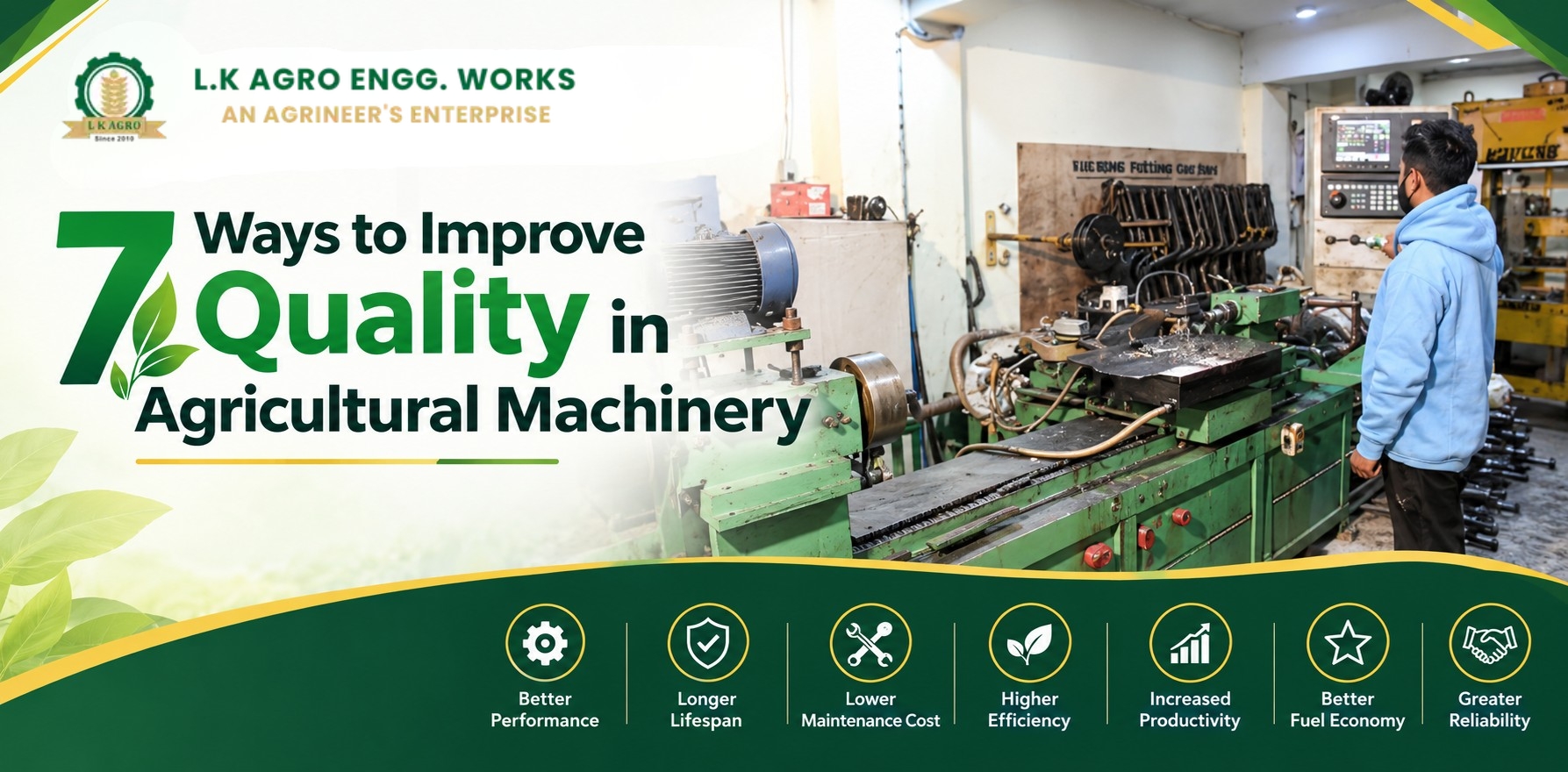
To Improve Quality in Agricultural Machinery, manufacturers need to focus on more than just material selection or machine appearance. Agricultural equipment works under demanding conditions, including dust, vibration, heavy loads, long operating hours, and changing field conditions. Quality therefore depends on accurate engineering, reliable materials, controlled manufacturing processes, proper testing, and consistent performance in real working environments.
For farmers and equipment buyers, better machinery quality can mean smoother operation, fewer unexpected breakdowns, longer component life, and more predictable maintenance requirements. For manufacturers, it also supports product reliability and long-term customer confidence.
In this article, we explore seven practical ways manufacturers can improve the quality of agricultural machinery and its critical components.
1. Start With Accurate Engineering and Product Design
Quality begins before a component reaches the manufacturing floor. A well-designed agricultural machine should be developed around its intended workload, operating environment, power requirements, and expected service life.
Engineers need to understand how individual components interact within the complete machine. A component that looks suitable on its own may create excessive vibration, wear, or stress when installed in an operating system.
For example, a combine harvester machine contains several moving assemblies that work continuously during harvesting. Components involved in crop movement and separation must maintain proper alignment and withstand repeated mechanical loads.
Design should therefore consider:
- Operating loads and torque
- Component dimensions and tolerances
- Vibration and dynamic forces
- Material strength
- Wear conditions
- Heat and environmental exposure
- Ease of installation and maintenance
Using engineering drawings, dimensional controls, and appropriate manufacturing specifications helps reduce errors before production begins.
Use application-based design for critical components
Agricultural machinery manufacturing becomes more reliable when designs are developed around actual field applications rather than generic specifications.
Manufacturers should consider the type of machine, operating speed, expected load, and working conditions when designing precision components. This approach can help create parts that perform consistently within the larger agricultural equipment system.
2. Select Materials Based on Performance Requirements
Material selection directly affects the strength, durability, and service life of agricultural machinery components.
A component exposed to continuous movement and mechanical stress needs a material capable of handling those conditions. Choosing a material solely because it is inexpensive can increase the risk of premature wear, deformation, or failure.
Manufacturers should evaluate factors such as tensile strength, hardness, fatigue resistance, machinability, and wear resistance before selecting a material.
The right material also depends on the component's function. A rotating shaft, structural frame, cutting component, and fastening element may all require different material characteristics.
| Quality Factor | What Manufacturers Should Consider |
|---|---|
| Strength | Ability to withstand working loads |
| Hardness | Resistance to surface wear |
| Fatigue resistance | Performance under repeated loading |
| Machinability | Accuracy and consistency during machining |
| Wear resistance | Expected service life in demanding applications |
| Material consistency | Reliable performance between production batches |
For precision agricultural components, maintaining consistent material quality is just as important as choosing the correct material grade.
3. Maintain Precision During the Manufacturing Process
Even a strong design and suitable material cannot compensate for poor manufacturing accuracy. Dimensional errors can affect how components fit, rotate, align, or transfer mechanical forces.
This is particularly important for rotating and precision-engineered parts. Small variations in dimensions can contribute to imbalance, vibration, uneven wear, or premature component failure.
A controlled manufacturing process should include accurate machining, proper tooling, dimensional inspection, and process monitoring.
Manufacturers can improve consistency by:
- Using suitable CNC and precision machining equipment
- Maintaining calibrated measuring instruments
- Controlling machining tolerances
- Monitoring critical dimensions during production
- Inspecting finished components
- Maintaining consistent production procedures
Precision is not simply about achieving a particular measurement. It is about ensuring that the finished component performs correctly within the machine assembly.
4. Strengthen Quality Control at Every Production Stage
Quality inspection should not begin only after manufacturing is complete. Effective quality control continues throughout the production cycle.
Incoming materials should be checked before they enter production. Machining operations should be monitored for critical dimensions, and finished components should undergo appropriate inspections before dispatch.
A structured quality-control system may include:
Raw material inspection:
Verify material specifications and condition before processing.
In-process inspection:
Check important dimensions and manufacturing parameters during production.
Final inspection:
Confirm dimensions, finish, fit, and other specified requirements.
Documentation:
Maintain inspection records to improve traceability and process consistency.
This approach helps manufacturers identify problems earlier instead of discovering them after a component has been installed in agricultural machinery.
Inspect critical dimensions before final assembly
Not every dimension carries the same importance. Manufacturers should identify critical features that directly influence component performance and prioritize their inspection.
For rotating components, areas such as journals, mounting points, keyways, and alignment-related dimensions may require particular attention depending on the component design.
5. Test Components Under Realistic Working Conditions
Laboratory measurements are important, but agricultural machinery ultimately has to work in real operating environments.
Field conditions can expose components to continuous vibration, dust, uneven loads, temperature variations, and extended operating cycles. Testing should therefore reflect the conditions a component is expected to experience.
Manufacturers can use suitable performance and durability testing to evaluate:
- Rotational stability
- Load-bearing capability
- Vibration behaviour
- Wear characteristics
- Dimensional stability
- Repeated-cycle performance
Testing can reveal weaknesses that may not be obvious during visual inspection.
For machinery components, the objective is not simply to confirm that a part works once. It is to understand how consistently it performs over repeated operating cycles.
6. Focus on Component Compatibility and Machine Balance
Agricultural machinery is a system of interconnected components. The quality of one part can influence the performance of several other parts.
This is especially relevant for assemblies containing rotating components. Incorrect dimensions, poor alignment, or imbalance can increase vibration and place additional stress on surrounding components.
A quality-focused manufacturer should therefore consider how a component interacts with the complete machine.
For a combine harvester machine, for instance, smooth movement within crop-processing and harvesting assemblies can influence operating efficiency and component durability.
Manufacturers should pay attention to:
- Correct component fit
- Shaft and bearing alignment
- Rotational balance
- Mounting accuracy
- Load distribution
- Compatibility with associated components
A precision component should not only meet its individual specifications; it should also function properly within the assembly for which it was designed.
7. Improve Manufacturing Through Feedback and R&D
Quality improvement should be an ongoing process rather than a one-time target. Manufacturers can use production data, inspection findings, service feedback, and customer observations to identify opportunities for improvement.
Research and development can help manufacturers refine component designs, manufacturing methods, material selection, and inspection procedures.
Feedback from equipment operators and agricultural machinery businesses can also reveal practical issues that may not appear during controlled testing.
For example, recurring field observations may indicate that a component needs improved dimensional control, greater resistance to repeated loading, or a design adjustment for easier installation.
A continuous improvement process can follow a simple cycle:
Design → Manufacture → Inspect → Test → Gather Feedback → Improve
This approach allows manufacturers to gradually strengthen product quality while responding to changing machinery requirements.
How Quality Improvements Benefit Agricultural Machinery?
Improving manufacturing quality can influence several aspects of machinery performance. The benefits are not limited to the individual component.
| Quality Improvement | Potential Operational Benefit |
|---|---|
| Better dimensional accuracy | Improved component fit and alignment |
| Suitable material selection | Greater resistance to operating stresses |
| Consistent machining | More reliable component performance |
| Strong inspection procedures | Earlier identification of defects |
| Durability testing | Better understanding of service performance |
| Improved balance | Reduced unwanted vibration |
| Continuous R&D | Ongoing product and process improvement |
For agricultural machinery manufacturers and buyers, these factors contribute to a more dependable equipment system.
Why Precision Matters in Combine Harvester Components?
Combine harvesters operate through multiple coordinated mechanical systems. During harvesting, components may experience continuous movement, repeated loading, vibration, and exposure to dust and crop residue.
This makes precision particularly important for components used in these machines.
A straw walker crankshaft, for example, is a precision-critical component within the straw walker mechanism. Its dimensions, strength, balance, and manufacturing accuracy can influence the movement of the associated assembly.
This is why manufacturers specializing in combine components need a strong understanding of agricultural equipment and practical operating conditions.
L.K. Agro Engg. Focuses on Precision Combine Components
With more than 40 years of experience, L.K. Agro Engg. Works focuses on precision-engineered combine components and agricultural machinery parts. The company specializes in manufacturing high-quality straw walker crankshafts designed for combine harvesting applications.
Its manufacturing approach focuses on factors such as dimensional accuracy, material quality, product reliability, and consistent engineering performance.
Rather than manufacturing generic components, L.K. Agro Engg. concentrates on precision-critical parts where strength, accuracy, and durability are important to machine operation.
This focused approach supports the requirements of OEMs, agricultural machinery brands, and equipment buyers looking for dependable combine components.
What Should Buyers Check Before Choosing Machinery?
Quality can be difficult to judge from appearance alone. Buyers should look beyond the external finish and consider the manufacturer's engineering and quality-control practices.
Before purchasing agricultural machinery or replacement components, consider asking:
- What materials are used for the component?
- Are important dimensions inspected during production?
- Does the manufacturer have relevant engineering experience?
- Are components tested for their intended application?
- Is product consistency maintained between batches?
- Can the manufacturer provide application-specific support?
- Does the company have experience with the type of agricultural machinery being used?
These questions can help buyers make decisions based on measurable manufacturing and performance factors rather than appearance alone.
Building Better Agricultural Machinery Through Quality
High-quality agricultural machinery is the result of many connected decisions. Accurate design, suitable materials, precision manufacturing, strict inspection, realistic testing, proper component compatibility, and continuous improvement all contribute to dependable equipment.
Manufacturers that treat quality as an ongoing process can better address the demanding conditions in which agricultural machinery operates.
For precision components such as straw walker crankshafts, these principles become particularly important because even a relatively small component can have a significant role within a larger mechanical assembly.
Frequently Asked Questions
1. What is the most important factor in agricultural machinery quality?
There is no single factor that determines overall quality. Design accuracy, material selection, manufacturing precision, inspection, testing, and component compatibility all work together to influence machinery performance and durability.
2. Why is material selection important for agricultural machinery?
Agricultural machinery components can experience repeated loads, vibration, friction, dust, and long operating cycles. Selecting a material with suitable strength, hardness, fatigue resistance, and wear characteristics helps the component perform according to its intended application.
3. How does precision manufacturing improve machine performance?
Precision manufacturing helps components maintain the required dimensions, fit, alignment, and balance. This can reduce issues such as excessive vibration, uneven wear, and poor component interaction within a machine assembly.
4. Why does testing matter in agricultural machinery manufacturing?
Testing provides information about how a component performs under specified operating conditions. Durability and performance testing can help identify potential weaknesses before products are used extensively in the field.
5. What should I look for in a combine component manufacturer?
Look for relevant engineering experience, controlled manufacturing processes, material-quality practices, dimensional inspection, application knowledge, and a clear focus on the type of component required. For precision combine parts, manufacturing consistency and product accuracy are particularly important.
Choose Precision for Your Agricultural Machinery
Improving agricultural machinery quality requires attention to every stage, from engineering and material selection to manufacturing, inspection, testing, and continuous improvement. Precision components can play an important role in maintaining the performance and reliability of the complete machine.
If you are looking for precision-manufactured straw walker crankshafts or dependable combine components, connect with L.K. Agro Engg. Works to discuss your machinery requirements and explore suitable component solutions.