


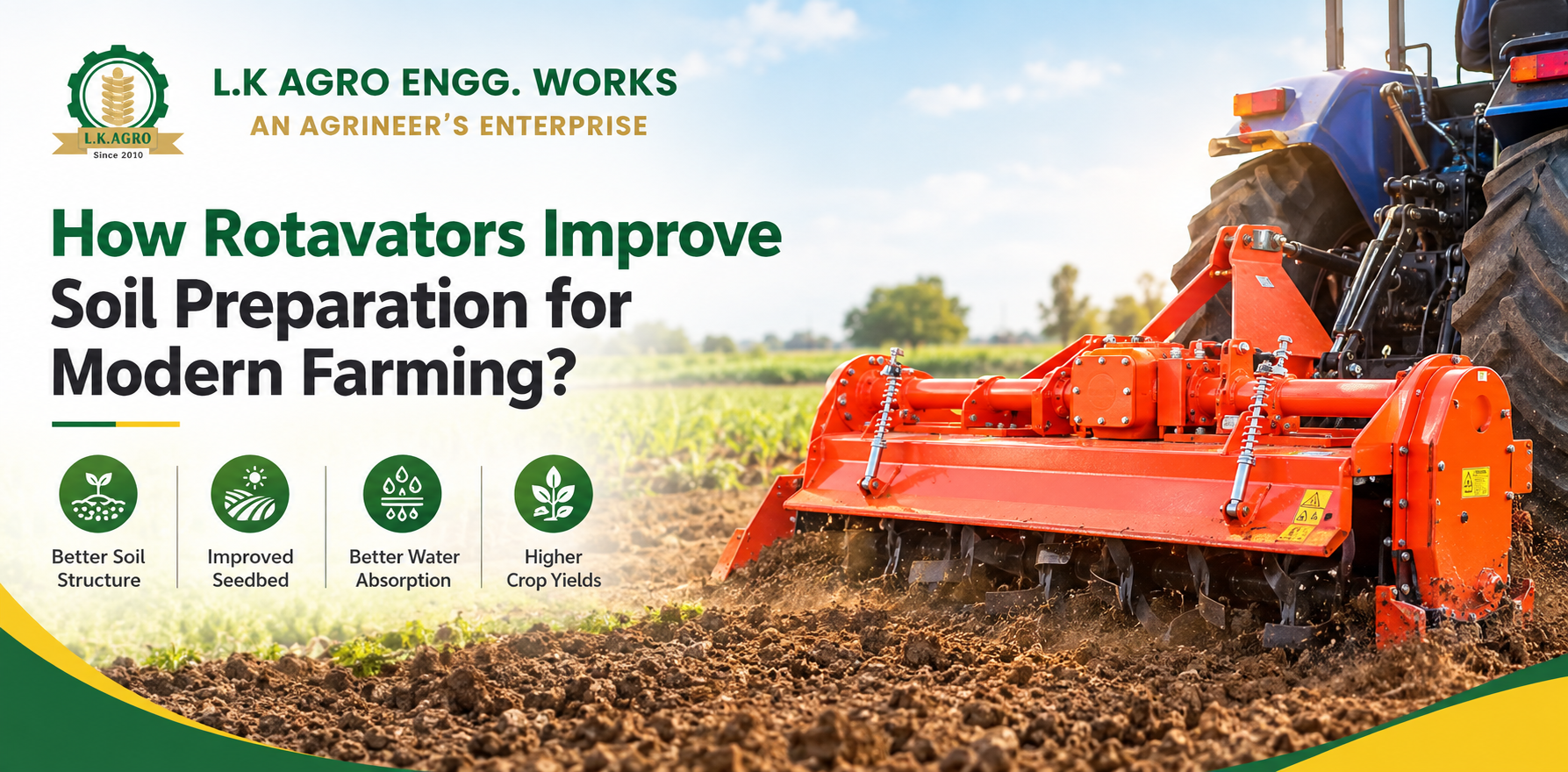
Efficient soil preparation is an important part of productive agriculture, and choosing the right equipment can make field operations faster and more consistent. A Rotary Tillage manufacturer develops implements designed to break, mix, and prepare soil before planting. When used correctly, rotavators can help farmers create a suitable seedbed, manage weeds, mix crop residues, and improve overall field preparation.
For Modern Farming, where farmers focus on efficient use of machinery, labour, fuel, and time, rotary tillage equipment has become an important agricultural implement. Different rotavator sizes can be selected according to tractor capacity, soil conditions, field size, and the type of cultivation being carried out.
What Is Rotary Tillage and How Does It Work?
Rotary tillage is a soil preparation method that uses rotating blades to cut and mix the soil. A rotavator is generally connected to a tractor through the three-point linkage and powered through the tractor's PTO system.
As the rotor turns, its blades enter the soil and break larger clods into smaller particles. At the same time, the blades mix soil, crop residues, and organic material within the working layer.
Unlike some conventional tillage operations that require separate passes for different tasks, rotary tillage can combine several soil preparation activities into one operation, depending on field conditions and the implement being used.
Its performance depends on several factors, including:
- Soil type and moisture
- Working depth
- Tractor horsepower
- Rotor speed
- Forward travel speed
- Blade design
- Field condition
- Quantity of crop residue
Correct adjustment is therefore important for achieving a uniform result without unnecessarily disturbing the soil.
How Rotavators Improve Soil Preparation Efficiency?
Rotavators can support several important field preparation activities. Their rotating blades provide mechanical action that helps prepare soil for subsequent sowing or planting operations.
1. Creates a More Suitable Seedbed
A well-prepared seedbed can provide better conditions for seed placement and early crop development. Rotavators break soil clods and distribute soil more evenly across the working area.
A suitable seedbed should generally have enough fine soil around the seed while retaining sufficient structure and moisture. The required condition varies according to the crop and soil type.
2. Helps Mix Crop Residues Into Soil
After harvesting, fields may contain stalks, leaves, and other crop residues. Rotary tillage can help incorporate these materials into the soil.
Mixing residues can support their decomposition and return organic material to the soil. However, residue management should be based on crop type, soil condition, moisture availability, and the farmer's overall cultivation system.
3. Supports Mechanical Weed Management
Young weeds can be disturbed and buried during rotary tillage. This makes rotavators useful as part of an integrated approach to weed management.
The effectiveness depends on weed growth stage and field conditions. Rotary tillage should not be considered a replacement for every weed-control method, but it can reduce unwanted vegetation during appropriate soil preparation operations.
4. Reduces the Need for Multiple Passes
One practical advantage of rotary tillage is that several soil preparation activities can potentially be completed in a single pass.
Fewer passes may help reduce:
- Tractor operating time
- Fuel consumption
- Labour requirements
- Field traffic
- Time between harvesting and the next crop
The actual savings vary depending on the soil, crop, tractor, implement settings, and number of operations being replaced.
Why Rotary Tillage Matters in Modern Farming?
Modern Farming increasingly focuses on efficient use of machinery, labour, fuel, and available time. Agricultural implements need to perform consistently while matching the requirements of different crops and field conditions.
Rotavators can contribute to this approach by combining soil breaking, mixing, and residue incorporation into one mechanised operation.
For farmers, selecting an implement should involve more than simply choosing the largest or most powerful machine. Working width, tractor compatibility, soil conditions, required depth, and the intended application should all be considered.
Choosing the Right Rotavator for Field Conditions
Rotavators are available in different working widths, and selecting the right size depends on tractor capacity, field conditions, and the type of soil preparation required. A suitable working width can help farmers complete field operations efficiently while maintaining consistent soil preparation.
L.K. Agro Engg. Works offers rotary tillage options in 7, 8, 9, and 10 feet working widths.
Rotavator 7 Feet
The Rotavator 7 feet is suitable for agricultural applications where a comparatively narrower working width is required. Its selection should be based on tractor compatibility, field conditions, and the required soil preparation depth.
Rotavator 8 Feet
The Rotavator 8 feet provides a wider working area and can be considered for suitable tractor and field applications where greater coverage is required.
Rotavator 9 Feet
The Rotavator 9 feet provides greater working width for agricultural operations where wider field coverage is suitable for the available tractor and operating conditions.
Rotavator 10 Feet
The Rotavator 10 feet offers a wider working width for appropriate agricultural applications. Before selecting this size, farmers should ensure that the tractor has sufficient power and PTO capacity.
The largest implement is not necessarily the right choice for every farm. Tractor horsepower, soil condition, field size, working depth, and operating requirements should be considered before selecting a rotavator.
| Rotavator Size | Key Consideration |
|---|---|
| 7 Feet | Suitable where a narrower working width is preferred |
| 8 Feet | Provides increased field coverage |
| 9 Feet | Suitable for wider field operations |
| 10 Feet | Designed for applications requiring greater coverage |
What Factors Matter When Choosing a Rotavator?
Selecting a rotavator requires consideration of more than working width. The implement should match the tractor and the specific field operation.
Tractor Power
The tractor should have sufficient power to operate the selected implement effectively. Using an implement that exceeds the tractor's suitable capacity can affect performance and increase mechanical stress.
Working Width
A wider rotavator can cover more area during each pass. However, greater working width generally requires appropriate tractor capacity and suitable field conditions.
Soil Type
Heavy, hard, dry, or moist soils can affect tillage performance. The machine settings and operating approach should be adjusted according to the soil condition.
Field Size
Larger fields may benefit from wider implements when tractor capacity and field conditions allow. Smaller or irregular fields may require a different working width for easier operation.
Working Depth
The required depth should be based on the crop and soil preparation objective. Operating at maximum depth is not always necessary or beneficial.
Maintenance
Regular inspection of blades, rotor components, gearbox, fasteners, PTO components, and other moving parts can help identify issues before they affect field operations.
How Agricultural Machinery Supports Better Field Work?
Modern agricultural operations depend on equipment that can perform specific tasks reliably. Agricultural machinery manufacturing therefore involves more than producing individual components. Equipment must be designed around practical field requirements, mechanical loads, operating conditions, and maintenance needs.
A reliable rotary tillage implement should have appropriate structural strength, properly manufactured components, and a design that supports consistent operation.
For manufacturers, precision in component production is particularly important because rotating assemblies operate under repeated mechanical loads. Proper manufacturing and inspection can contribute to equipment reliability and service life.
Rotary Tillage and Harvester Combine Machine Operations
Soil preparation is closely connected to harvesting and the next crop cycle. A harvester combine machine can complete harvesting and threshing operations efficiently, but the field may still require residue management and soil preparation before the next crop is established.
This creates a connection between harvesting equipment and subsequent tillage operations.
After harvesting, farmers may assess:
- The amount and type of crop residue left in the field.
- Soil moisture and field conditions.
- Whether residue incorporation is required.
- The required depth of soil preparation.
- Tractor and implement compatibility.
- The timing of the next sowing operation.
Rotary tillage can then be used where appropriate to prepare the field for the following crop.
What to Check Before Using a Rotavator?
Correct operation is just as important as selecting the right implement. Before starting work, farmers should inspect the machine and adjust it according to field requirements.
Inspect the Blades and Rotor
Damaged, excessively worn, or loose blades can affect soil preparation. Inspect the rotor and blade mounting points before field operation.
Check Tractor Compatibility
The tractor should have sufficient power and PTO capability for the selected implement. Operating an unsuitable combination can reduce efficiency and increase mechanical stress.
Set the Working Depth
Avoid automatically selecting maximum depth. The appropriate depth depends on the crop, soil, moisture level, and purpose of tillage.
Adjust Operating Speed
Excessive speed may produce inconsistent results, while an unnecessarily low speed can reduce field efficiency. Operators should select a speed appropriate for the soil condition and implement.
Maintain the Equipment
Regular inspection of bearings, gearbox components, blades, fasteners, PTO components, and other moving parts can help identify problems before they affect field operations.
Benefits of Working With an Experienced Manufacturer
A Rotary Tillage manufacturer in India needs to understand the mechanical and agricultural requirements of equipment used under different field conditions.
Manufacturing experience can be valuable when designing implements that need to withstand repeated loads, soil resistance, vibration, and varying operating conditions.
L.K. Agro Engg. Works has more than 40 years of experience, along with 15+ OEM partnerships and 10k+ crankshafts delivered. Its rotary tillage implements are manufactured using quality materials and precision engineering for agricultural applications.
The focus is on practical equipment designed to support soil mixing, weed management, and land preparation across different farming conditions.
Rotary Tillage as Part of Efficient Farm Management
Rotary tillage is not suitable for every field or every cultivation system. Excessive or unnecessary tillage can disturb soil structure and may increase soil erosion or moisture loss under certain conditions.
Farmers should therefore consider rotary tillage as one component of an overall soil-management strategy.
The right approach depends on factors such as crop rotation, soil type, residue levels, climate, available machinery, and the timing of planting.
Using the implement only when required and adjusting it correctly can help achieve the desired soil condition without unnecessary field operations.
Key Factors for Better Rotavator Performance
For consistent results, farmers should focus on the complete operation rather than the implement alone.
Match the machine: Select a rotavator that is compatible with the tractor.
Understand the soil: Soil moisture and texture can significantly affect tillage performance.
Set the correct depth: Deeper operation is not always better. Use a depth appropriate for the cultivation requirement.
Maintain the blades: Sharp and properly secured blades support consistent soil cutting and mixing.
Avoid unnecessary passes: Plan field operations to reduce repeated soil disturbance.
Monitor field results: Check whether the soil is being prepared uniformly and adjust settings when required.
Conclusion: Improving Soil Preparation With Rotavators
Rotavators can simplify several aspects of soil preparation by breaking soil clods, mixing residues, supporting weed management, and creating a suitable seedbed. When correctly matched with the tractor and operated according to field conditions, they can contribute to more efficient agricultural operations.
The right rotary tillage equipment should be selected based on working width, tractor capacity, soil type, required depth, crop requirements, and maintenance considerations rather than size alone.
For farmers and agricultural equipment businesses looking for dependable rotary tillage solutions, L.K. Agro Engg. Works combines manufacturing experience with precision engineering to develop equipment for practical farming applications.
Looking for a suitable rotavator for your farming requirements? Contact L.K. Agro Engg. Works to discuss your application, tractor compatibility, working width, and equipment requirements.
Frequently Asked Questions
1. What is a rotavator used for in farming?
A rotavator is used for soil preparation. Its rotating blades break soil clods, mix soil and crop residues, and can help create a suitable seedbed before sowing.
2. How does rotary tillage help farmers?
Rotary tillage can combine several soil preparation activities into fewer field passes. Depending on field conditions, it can help with soil mixing, residue incorporation, weed disturbance, and seedbed preparation.
3. How do I choose the right rotavator?
Consider tractor horsepower, working width, soil type, required working depth, crop requirements, field size, and the quantity of crop residue before selecting a rotavator.
4. Can a rotavator be used after harvesting?
Yes. A rotavator may be used after harvesting to prepare the field, manage suitable crop residues, and create conditions for the next crop. Its use should depend on soil condition and the farmer's cultivation system.
5. Why is agricultural machinery manufacturing important for rotavators?
Agricultural machinery manufacturing involves designing and producing equipment capable of handling repeated mechanical loads and varying field conditions. Proper material selection, precision manufacturing, and inspection can support reliable equipment performance.