


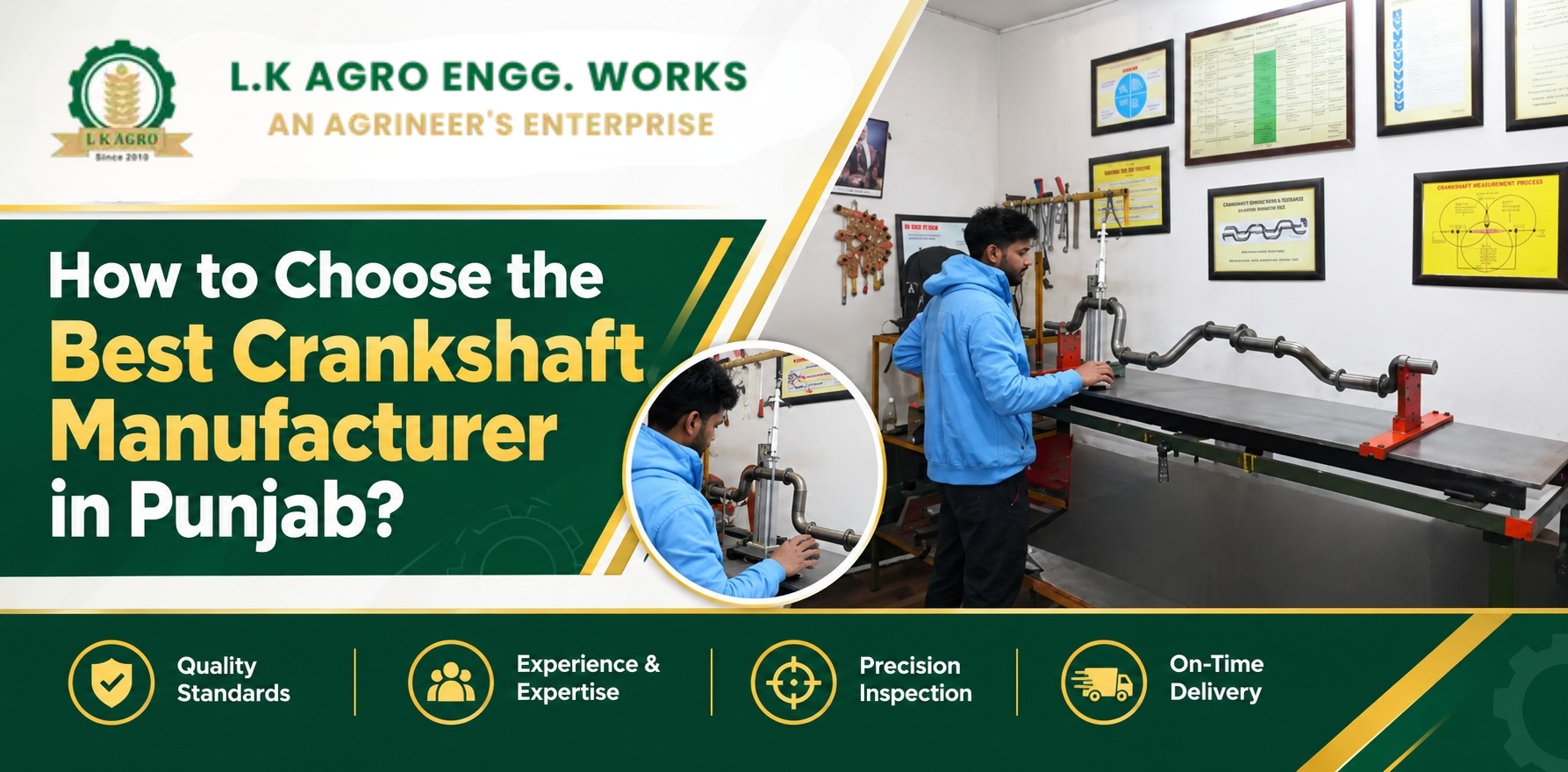
Choosing the Best Crankshaft Manufacturer is an important decision for agricultural machinery businesses, equipment dealers, and combine harvester manufacturers. A well-designed crankshaft supports consistent machine operation, smooth mechanical movement, and dependable performance during demanding harvesting seasons. Before selecting a supplier, buyers should evaluate manufacturing experience, material quality, dimensional accuracy, production capabilities, and after-sales support.
For businesses looking for a reliable Crankshaft Manufacturer in Punjab, understanding these factors can help them make an informed purchasing decision and avoid unnecessary maintenance costs.
Punjab has a strong agricultural machinery industry, with Ludhiana serving as an important manufacturing hub. From replacement components to original equipment manufacturing (OEM) requirements, buyers need crankshafts that meet the technical specifications of their machines. Selecting the right manufacturer can help improve equipment reliability, reduce unexpected downtime, and support long-term operational efficiency.
Why Does the Right Crankshaft Manufacturer Matter?
A crankshaft is a critical mechanical component that converts or transfers motion within a machine's operating mechanism. In agricultural equipment, its performance depends on the application, design, material properties, and manufacturing accuracy.
For combine harvesting machines, straw walker crankshafts play an important role in the movement of the straw walker assembly. This mechanism helps separate remaining grain from straw after threshing. The crankshaft must withstand continuous movement, vibration, and repeated mechanical loads during harvesting operations.
Working with an experienced manufacturer offers several practical advantages:
-
Consistent performance: Properly manufactured components support reliable machine operation.
-
Better dimensional accuracy: Correct dimensions help ensure compatibility with the intended assembly.
-
Reduced maintenance issues: Suitable materials and controlled manufacturing processes can reduce premature component failure.
-
Reliable replacement support: A dependable supplier can help businesses source compatible components when required.
-
Long-term value: Quality manufacturing can reduce the frequency of replacements and associated downtime.
Therefore, buyers should evaluate more than the initial purchase price when choosing a crankshaft supplier.
Check the Manufacturer's Industry Experience and Expertise
Manufacturing experience is one of the first factors to consider when evaluating crankshaft manufacturers. Experienced manufacturers are more likely to understand application-specific requirements, common fitting challenges, and the production tolerances needed for agricultural machinery components.
However, experience should be supported by actual manufacturing capabilities rather than years in business alone.
Before finalising a supplier, consider the following questions:
-
How long has the company manufactured agricultural machinery components?
-
Does it understand straw walker crankshaft applications?
-
Can it manufacture components according to technical drawings or approved samples?
-
Does it have experience supplying OEMs and established machinery brands?
-
Can its team explain the product's technical specifications clearly?
A manufacturer with relevant agricultural engineering experience can help identify suitable component designs and clarify compatibility requirements before production begins.
For buyers sourcing a Crankshaft Manufacturer in Punjab, these checks can help distinguish specialised manufacturers from suppliers that primarily trade in general machinery components.
Evaluate Material Quality and Manufacturing Processes
The material used in a crankshaft directly influences its strength, fatigue resistance, wear characteristics, and service life. The right material depends on the component design, operating loads, machine application, and engineering specifications.
A reliable manufacturer should be able to explain the material selected for the intended application and the processes used to produce the component.
Review Material Selection and Heat Treatment
Ask whether the manufacturer follows documented material specifications and whether relevant inspection records are available. Where the design requires heat treatment, the process should be appropriate for the selected material and the component's intended use.
Incorrect material selection or unsuitable heat treatment may contribute to premature wear, cracking, or deformation under demanding operating conditions.
Check Machining and Surface Finish
Accurate machining is essential for achieving the required dimensions, alignment, and fit. Poorly finished surfaces or dimensional inconsistencies can create assembly difficulties and affect component performance.
Look for a manufacturer that uses suitable machining equipment and checks critical dimensions during production. Depending on the design, important inspection points may include shaft diameter, bearing locations, journal dimensions, overall length, and alignment.
Assess Quality Control and Dimensional Accuracy
Quality control is a key consideration when selecting the Best Crankshaft Manufacturer. Even a component made from suitable material can cause problems if its dimensions do not match the machine's requirements.
A structured inspection process helps identify manufacturing defects before the component reaches the customer.
| Quality factor | What buyers should check | Why it matters |
|---|---|---|
| Dimensional accuracy | Measurements against approved drawings | Supports correct fitment |
| Material quality | Material specifications and relevant records | Helps verify suitability |
| Surface finish | Inspection of critical machined surfaces | Supports proper assembly and operation |
| Alignment and runout | Checks where required by the design | Helps reduce unwanted vibration |
| Workmanship | Visual inspection for defects | Helps identify production issues |
| Final inspection | Documented checks before dispatch | Improves quality consistency |
Not every crankshaft requires identical inspection methods. The manufacturer should select appropriate checks according to the component's design and engineering requirements.
Buyers can also ask about rejection procedures, traceability, and how manufacturing inconsistencies are handled. These details provide a clearer picture of the supplier's quality management practices.
Confirm Compatibility With Your Combine Harvester Machine
A crankshaft must match the intended machinery application. Ordering a component based only on its general name or appearance can result in incorrect fitment, unnecessary delays, and additional costs.
When purchasing a straw walker crankshaft for a combine harvester machine, confirm the relevant technical details before placing an order.
These may include:
-
Machine make and model
-
Existing crankshaft part number, if available
-
Overall dimensions and shaft diameter
-
Bearing and mounting specifications
-
Crank geometry and connection points
-
Required material and manufacturing specifications
-
Quantity and expected delivery schedule
If a part number is unavailable, provide the manufacturer with an approved technical drawing or a sample for assessment, where practical.
A competent supplier should review the information and clarify any uncertainties before confirming production. This is especially important when sourcing components for different combine models or older agricultural machinery.
Look for Custom Manufacturing and OEM Capabilities
Agricultural machinery manufacturers may require crankshafts in different sizes, configurations, and specifications. A supplier with suitable custom manufacturing capabilities can support these requirements more effectively than one offering only standard components.
OEM buyers should assess whether the manufacturer can work from approved drawings, engineering specifications, and quality requirements. They should also confirm the supplier's ability to maintain consistency across repeat orders.
Custom manufacturing capabilities may include:
-
Production based on approved technical drawings
-
Adaptation to specified dimensions and design requirements
-
Prototype development, where available
-
Batch production for recurring orders
-
Inspection against agreed specifications
-
Coordination on product improvements
Customisation should always be based on engineering approval. Modifying a crankshaft without evaluating its effect on strength, balance, fitment, and operating loads may compromise reliability.
For distributors and machinery manufacturers, a supplier that communicates clearly throughout the production process can help simplify procurement and reduce avoidable errors.
Compare Pricing, Delivery Time, and Overall Value
Price is an important purchasing factor, but the lowest quotation does not necessarily represent the best value. Differences in material quality, machining accuracy, inspection procedures, and delivery commitments can influence the total cost of ownership.
When comparing quotations from crankshaft manufacturers, review the complete offer rather than focusing only on the unit price.
| Comparison point | Questions to ask |
|---|---|
| Quoted price | What does the quotation include? |
| Material and specifications | Are they clearly documented? |
| Production lead time | When will the order be ready? |
| Delivery arrangements | Who manages packaging and transportation? |
| Minimum order quantity | Can the supplier accommodate your requirement? |
| Warranty terms | What conditions apply to manufacturing defects? |
| Repeat orders | Can the same specifications be maintained? |
For agricultural businesses, timely delivery is particularly important before and during harvesting periods. A delayed replacement component may keep machinery out of operation when it is needed most.
Discuss expected production timelines, order quantities, and delivery arrangements in advance. For recurring requirements, planning orders ahead of peak demand can help reduce supply disruptions.
Check After-Sales Service and Technical Support
A manufacturer's responsibility should not end when the product is dispatched. Clear communication and responsive support are valuable if a component requires inspection, clarification, or replacement.
Before choosing a supplier, ask about its approach to customer queries, product-related concerns, and manufacturing defects. Understand the applicable warranty conditions and the information required to raise a claim.
Reliable after-sales support can be particularly useful for equipment dealers, fleet operators, and OEMs managing multiple machines.
It is also worth checking whether the supplier can help clarify product identification, installation-related specifications, and replacement requirements. Such assistance can make future procurement more straightforward.
A manufacturer that maintains clear documentation and responds professionally to technical questions can become a more dependable long-term business partner.
Why Consider an Established Manufacturer in Ludhiana?
Ludhiana is a recognised industrial centre in Punjab, with manufacturing businesses serving agricultural machinery and engineering applications. Buyers searching for a harvester combine machine in Punjab may also need dependable component suppliers who understand the requirements of local equipment manufacturers and agricultural markets.
An established local manufacturer can offer practical advantages, including easier communication, more convenient coordination, and the potential for smoother follow-up on orders. However, location alone should not determine the final choice.
Buyers should still assess manufacturing expertise, quality control, product compatibility, delivery performance, and customer support before making a decision.
L.K. Agro Engg. Works is an agricultural engineering business with over 40 years of experience in the industry. The company manufactures straw walker crankshafts for combine harvesting machines and serves major brands and OEMs, including KARTAR COMBINES. Its stated capabilities include advanced research and development, manufacturing, customised solutions, and after-sales support.
When evaluating the company or any other supplier, buyers should discuss their specific application, required specifications, inspection expectations, and order volume to determine whether the manufacturer is suitable for their needs.
Final Checklist Before Selecting a Crankshaft Supplier
Before placing your order, use this checklist to compare shortlisted manufacturers objectively.
-
Relevant experience in agricultural machinery components
-
Suitable material specifications and manufacturing processes
-
Documented dimensional and quality inspection procedures
-
Compatibility with the intended machine model
-
Ability to meet custom or OEM requirements, if needed
-
Transparent pricing and agreed delivery timelines
-
Clear warranty terms and after-sales support
-
Consistent communication and order documentation
Compare the responses from multiple suppliers where possible. This will help you identify a manufacturer that meets your technical, commercial, and operational requirements.
Conclusion
Choosing the Best Crankshaft Manufacturer requires careful evaluation of experience, material quality, machining accuracy, quality control, machine compatibility, production capacity, and customer support. For agricultural machinery businesses, these factors can make a meaningful difference to equipment reliability, maintenance planning, and procurement efficiency.
Rather than selecting a supplier based solely on price or location, focus on documented quality, clear technical communication, and the ability to meet your specific requirements.
If you are looking for a dependable Crankshaft Manufacturer in Punjab, connect with L.K. Agro Engg. Works to discuss your straw walker crankshaft requirements. Share your machine model, technical drawing, sample details, or required quantity to help the team understand your application and recommend the next steps.
Contact L.K. Agro Engg. Works today to discuss your crankshaft manufacturing requirements and find a solution suited to your agricultural machinery needs.
Frequently Asked Questions
1. How do I choose the Best Crankshaft Manufacturer?
Evaluate the manufacturer's industry experience, material specifications, machining capabilities, quality inspection procedures, product compatibility, delivery commitments, and after-sales service. Request relevant technical documentation before placing an order.
2. What should I check before buying a straw walker crankshaft?
Confirm the machine make and model, part number, shaft dimensions, mounting points, crank geometry, material requirements, and other relevant specifications. An approved drawing or sample can help the manufacturer verify compatibility.
3. Why is dimensional accuracy important in crankshaft manufacturing?
Dimensional accuracy helps ensure that a crankshaft fits the intended assembly and operates according to its design requirements. Incorrect dimensions may cause installation difficulties, unwanted vibration, premature wear, or mechanical problems.
4. Can a crankshaft manufacturer provide customised components?
Yes, manufacturers with suitable engineering and production capabilities may produce crankshafts according to approved drawings, samples, and OEM specifications. Custom designs should be reviewed and approved by qualified engineering personnel before manufacturing.
5. Why consider a Crankshaft Manufacturer in Punjab?
Choosing a suitable manufacturer in Punjab may make communication, order coordination, and follow-up more convenient for regional buyers. However, manufacturing quality, technical expertise, delivery reliability, and customer support should remain the primary selection criteria.