


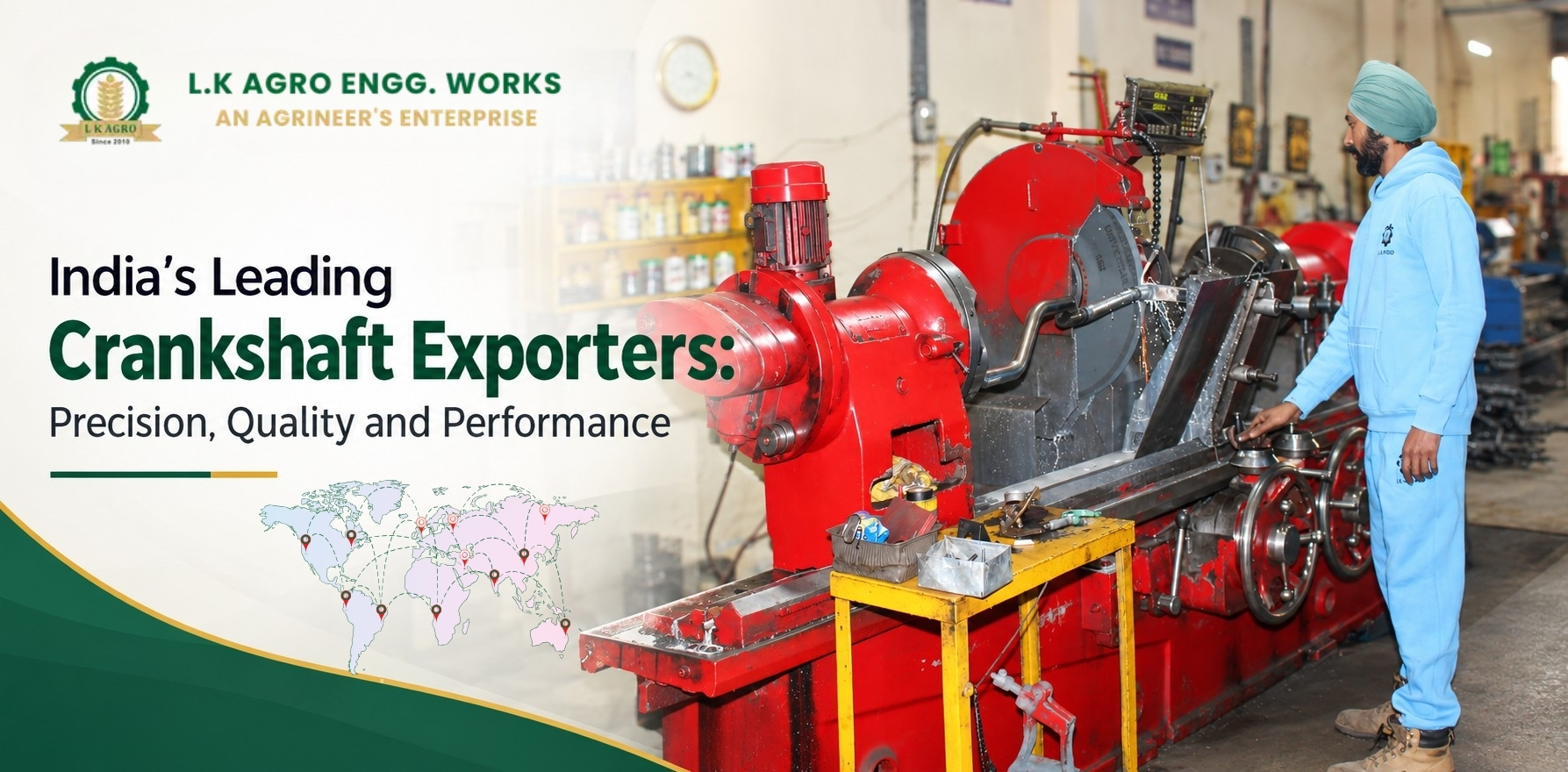
Crankshafts play an essential role in agricultural machinery by converting rotational motion into the mechanical movement required for efficient operation. When choosing India’s Leading Crankshaft Exporters, buyers should consider manufacturing precision, material quality, product consistency, customization capabilities, and reliable supply. These factors are especially important for combine harvesters, where dependable components support smooth operation during demanding harvesting conditions.
India has a growing manufacturing base for agricultural machinery and its components, creating opportunities for domestic and international buyers to source precision-engineered parts. Experienced manufacturers can support original equipment manufacturers (OEMs), agricultural equipment companies, distributors, and aftermarket suppliers with components designed for specific machinery requirements.
L.K. Agro Engg. Works specializes in manufacturing straw walker crankshafts and precision-engineered combine harvester components. With over 40 years of experience, 15+ OEM partnerships, and more than 10,000 crankshafts delivered, the company focuses on product quality, engineering accuracy, and solutions tailored to customer specifications.
Why India Is a Growing Crankshaft Exporting Hub?
India’s engineering and agricultural machinery sectors provide a strong foundation for manufacturing components used in harvesting equipment. Access to machining capabilities, skilled manufacturing professionals, and established industrial supply chains helps Indian manufacturers serve customers in different markets.
For international buyers, working with crankshafts exporters India can offer access to customized components, competitive sourcing options, and manufacturers familiar with agricultural machinery applications. However, the right supplier should be selected based on technical capabilities and quality standards rather than price alone.
Several factors contribute to India's role in agricultural component manufacturing:
-
Engineering expertise: Skilled teams support component production according to technical drawings and specifications.
-
Precision manufacturing: CNC machining helps achieve dimensional accuracy and repeatability.
-
Product customization: Manufacturers can produce different crankshaft configurations to suit specific machinery.
-
Scalable production: Established facilities can support recurring orders and varying production volumes.
-
Export-oriented supply: Experienced suppliers can coordinate packaging, documentation, and dispatch requirements for international customers.
These capabilities make India a practical sourcing destination for businesses seeking dependable agricultural machinery components.
What Makes a Crankshaft Manufacturer Reliable?
Selecting a crankshaft supplier requires more than comparing quotations. Buyers need to understand how components are manufactured, inspected, and matched to their intended applications.
Material Quality and Engineering Accuracy
The material used in a crankshaft directly affects its strength, durability, and ability to withstand operational loads. High-grade alloy steel is commonly selected for demanding mechanical applications because its properties can be tailored through suitable material specifications and heat treatment.
Manufacturers should use materials appropriate for the intended application and maintain consistency between production batches. Material traceability and inspection records can also help buyers evaluate supplier reliability.
Dimensional accuracy is equally important. Incorrect measurements or inconsistent machining may cause fitting difficulties, vibration, premature wear, or unnecessary maintenance.
CNC Machining and Quality Control
Computer Numerical Control (CNC) machining helps manufacturers produce components with consistent dimensions and accurately machined features. Depending on the design, inspection may cover critical dimensions, shaft geometry, surface finish, and other application-specific characteristics.
A dependable manufacturer should establish suitable inspection procedures throughout production rather than relying exclusively on a final visual check.
Customization for OEM Requirements
Agricultural machinery manufacturers may require specific crankshaft dimensions, step configurations, mounting arrangements, or other design features. Suppliers capable of working from OEM drawings and technical specifications can help ensure that components match the intended assembly.
Before production begins, buyers should confirm drawing revisions, dimensional tolerances, material requirements, inspection criteria, and expected delivery schedules.
Types of Straw Walker Crankshafts Available
Straw walker crankshafts are important components in combine harvesters. Their configuration depends on the machine design and the mechanical requirements of the harvesting system.
Different step configurations provide options for machinery manufacturers and replacement-part suppliers. The correct choice should always be based on the relevant equipment model, dimensions, and approved technical specifications.
L.K. Agro Engg. Works manufactures the following straw walker crankshaft configurations:
| Crankshaft type | Typical sourcing consideration |
|---|---|
| 3 Step Straw Walker Crankshaft | Confirm the required dimensions and machine compatibility |
| 4 Step Straw Walker Crankshaft | Check the configuration against OEM specifications |
| 5 Step Straw Walker Crankshaft | Verify mounting details and dimensional requirements |
| 6 Step Straw Walker Crankshaft | Confirm the complete design before placing an order |
| Custom Crankshaft Solutions | Provide OEM drawings and technical specifications |
The step count alone does not determine whether a crankshaft will fit a particular combine harvester. Buyers should share the machine model, existing component measurements, drawings, and any relevant part number before finalizing an order.
How to Evaluate Crankshafts Exporters in India?
Finding a suitable export partner requires a structured assessment of manufacturing capabilities, quality assurance, and communication. A supplier that understands the technical requirements of agricultural machinery can help reduce sourcing risks and improve consistency across repeat orders.
Review Manufacturing Experience and Expertise
Manufacturing experience can indicate familiarity with recurring production requirements, customer specifications, and component development. Buyers should review the supplier's relevant product range, manufacturing processes, and ability to handle both standard and customized orders.
For agricultural machinery components, experience with combine harvester applications is particularly relevant because these products must meet the requirements of specific mechanical assemblies.
Verify Quality Assurance Procedures
Ask potential suppliers about their inspection process, measurement equipment, material specifications, and quality documentation. Depending on the application, buyers may also require dimensional inspection reports, material certificates, or additional testing.
Clear quality requirements established before production help both parties understand the acceptance criteria.
Assess Production Capacity and Delivery
Export buyers often need a supplier that can manage initial orders as well as repeat shipments. Discuss order quantities, production lead times, packaging, dispatch schedules, and the process for handling urgent requirements.
Consistent communication is especially valuable when orders involve multiple crankshaft configurations or custom manufacturing.
Compare Technical Support and Customization
A capable supplier should be able to review drawings, clarify measurements, and communicate any technical questions before production. This process helps minimize misunderstandings and reduces the risk of receiving components that do not meet the intended application requirements.
Check Export Documentation and Packaging
International shipments may require commercial invoices, packing lists, certificates, or other documents depending on the destination and transaction. Buyers should confirm the applicable requirements with the supplier and their logistics partner.
Suitable packaging also helps protect machined surfaces and prevent damage during storage and transportation.
The Role of Quality in Crankshaft Performance
A crankshaft's performance depends on several interconnected factors, including material properties, dimensional accuracy, manufacturing consistency, and suitability for its intended application.
Even a small dimensional variation can affect assembly compatibility. Similarly, unsuitable material properties or inadequate process control may reduce service life under demanding operating conditions.
For agricultural equipment manufacturers, consistent component quality helps support dependable assembly and maintenance planning. Distributors and aftermarket suppliers also benefit from accurate product identification, as it helps them match replacement parts to the correct machinery.
To support reliable procurement, buyers should consider the following quality checkpoints:
-
Confirm material grade and applicable specifications.
-
Verify critical dimensions against approved drawings.
-
Review machining quality and surface finish.
-
Check any specified heat treatment or hardness requirements.
-
Request inspection documentation when required.
-
Confirm product identification and packaging before dispatch.
Quality requirements should be defined according to the component's engineering design rather than relying on general descriptions such as premium quality.
Who Needs Precision-Engineered Crankshafts?
Crankshaft manufacturers serve different customer groups across the agricultural machinery supply chain. Each group has its own procurement requirements, order volumes, and technical considerations.
Original Equipment Manufacturers (OEMs): OEMs require components that match approved engineering drawings and production standards. Consistency across batches is important for assembly and manufacturing schedules.
Combine Harvester Manufacturers: These businesses need components compatible with the design and operating requirements of their harvesting machinery.
Agricultural Machinery Companies: Equipment manufacturers and assemblers may source crankshafts for new machines, replacement assemblies, or specific product lines.
Distributors and Dealers: These buyers need clearly identified components, dependable replenishment, and suitable packaging to serve their customers.
Aftermarket Spare Parts Suppliers: Aftermarket businesses benefit from accurate product specifications and compatibility checks that help reduce incorrect-part orders.
By understanding these requirements, manufacturers can provide more suitable solutions for different stages of the agricultural machinery supply chain.
The Future of Crankshaft Exporting in India
The future of crankshaft exporting in India will depend on manufacturers' ability to combine engineering accuracy, efficient production, quality assurance, and responsive customer service. As agricultural machinery requirements evolve, buyers may increasingly prioritize suppliers that can accommodate specific designs, maintain consistent production standards, and support long-term sourcing relationships.
Manufacturing improvements such as better process monitoring, advanced CNC capabilities, and more systematic inspection can help improve repeatability and production efficiency. Digital drawing management and clearer communication between buyers and suppliers can also reduce errors during customized manufacturing.
International buyers are likely to continue evaluating suppliers on more than their quoted prices. Product consistency, technical responsiveness, lead-time management, documentation, and the ability to meet agreed specifications all contribute to a successful export partnership.
For Indian manufacturers, these expectations create opportunities to strengthen their position in international agricultural component supply chains. Building long-term customer relationships through transparent communication and dependable manufacturing practices will remain an important part of sustainable export growth.
L.K. Agro Engg. Works focuses on straw walker crankshafts and customized manufacturing based on OEM drawings and technical specifications. Its experience, established OEM partnerships, and range of 3 Step, 4 Step, 5 Step, and 6 Step configurations support customers seeking agricultural machinery components tailored to their requirements.
Why Choose L.K. Agro Engg. Works for Crankshafts?
Choosing a supplier involves finding a balance between engineering requirements, manufacturing capability, and dependable service. L.K. Agro Engg. Works manufactures straw walker crankshafts using high-grade alloy steel, CNC machining, and quality control processes designed to support precision and reliable performance.
Key reasons to consider the company include:
-
40+ years of experience: Manufacturing experience in agricultural machinery components.
-
15+ OEM partnerships: Experience working with original equipment manufacturing requirements.
-
10,000+ crankshafts delivered: A track record of crankshaft supply.
-
Multiple configurations: 3 Step, 4 Step, 5 Step, and 6 Step straw walker crankshafts.
-
Custom manufacturing: Solutions based on customer drawings and technical specifications.
-
Broad customer support: Supply for OEMs, combine harvester manufacturers, agricultural machinery businesses, distributors, dealers, and aftermarket suppliers.
These capabilities make the company a potential sourcing partner for buyers seeking crankshafts for combine harvesters and related agricultural equipment.
Frequently Asked Questions
1. What should buyers look for in India's leading crankshaft exporters?
Buyers should assess manufacturing experience, material quality, machining capabilities, dimensional inspection, customization options, delivery reliability, and export documentation. Technical compatibility and consistent quality should take priority over price alone.
2. What types of straw walker crankshafts are available?
Available configurations include 3 Step, 4 Step, 5 Step, and 6 Step straw walker crankshafts. Custom options may also be available according to OEM drawings and technical specifications. Buyers should verify compatibility with their machinery before ordering.
3. Can Indian crankshaft manufacturers produce custom designs?
Yes, manufacturers with suitable engineering and machining capabilities can produce custom crankshafts based on approved drawings and specifications. Buyers should provide dimensions, material requirements, tolerances, and application details before production.
4. Why is CNC machining important for crankshaft manufacturing?
CNC machining supports dimensional accuracy and repeatability when properly programmed and controlled. These qualities help manufacturers produce components that meet defined specifications and fit the intended mechanical assembly.
5. Does L.K. Agro Engg. Works supply crankshafts for international buyers?
L.K. Agro Engg. Works states that it supplies agricultural machinery components to customers in India and international markets. Buyers can contact the company through its official website to discuss product configurations, OEM specifications, customization requirements, and shipping arrangements.
Contact L.K. Agro Engg. Works for Crankshaft Solutions
Choosing the right crankshaft supplier can support consistent component quality, reliable assembly, and long-term procurement planning. Whether you are an OEM, combine harvester manufacturer, agricultural machinery company, distributor, or aftermarket supplier, selecting components that meet your exact specifications is essential.
Contact L.K. Agro Engg. Works to discuss your straw walker crankshaft requirements, including 3 Step, 4 Step, 5 Step, 6 Step, and customized designs. Share your OEM drawings or technical specifications to help identify a suitable manufacturing solution.